Audiologist vs. Hearing Aid Dispenser in New York State
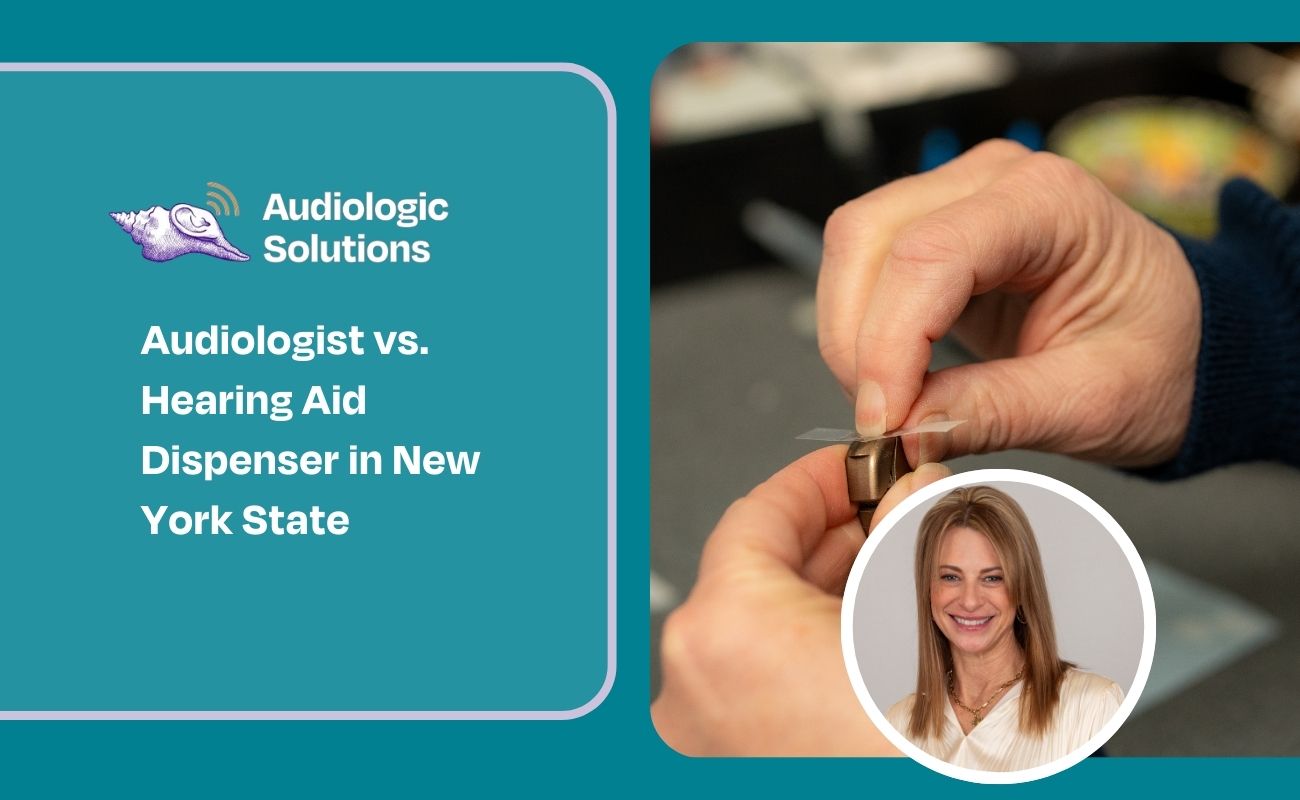

When searching for help with hearing loss, you may come across two types of professionals — audiologists and hearing aid dispensers. Understanding the difference can help you make an informed decision about your hearing healthcare.
A hearing aid dispenser in New York State is licensed to conduct basic hearing screenings and fit and sell hearing aids. The educational requirements are more limited compared to an audiologist. Dispensers are not required to hold a graduate or doctoral degree, and their training focuses primarily on the fitting and sale of amplification devices rather than the full diagnostic picture of hearing health.
An audiologist is a licensed healthcare professional who specializes in the evaluation, diagnosis, and treatment of hearing and balance disorders. In New York State, audiologists must hold a master's degree at minimum, and the current clinical standard is the Doctor of Audiology (Au.D.) — a four-year doctoral degree that includes both academic training and supervised clinical rotations.
The scope of practice for audiologists extends well beyond fitting hearing aids. Audiologists are trained to administer and interpret a full range of diagnostic tests, identify medical conditions that require referral to a physician, evaluate and manage tinnitus, assess auditory processing disorders, and work with patients across the full lifespan — from newborns to older adults.
Hearing loss is not always straightforward. What sounds like a simple case of age-related hearing loss could involve a medically treatable condition, a problem with auditory nerve function, or an issue that requires coordination with an ear, nose, and throat physician. An audiologist has the clinical training to identify these nuances and respond appropriately.
A hearing aid dispenser, by contrast, is not trained to diagnose hearing disorders or recognize conditions outside the scope of amplification fitting. If something more complex is going on, that may go undetected.
There is also the question of what happens after a hearing aid is fit. Proper programming of a hearing aid requires a thorough understanding of audiological test results, the patient's lifestyle, and the acoustic characteristics of their ear canal. One of the most effective tools for verifying a proper fit is Real Ear Measurement (REM) — a procedure where small probe microphones are placed in the ear canal to measure exactly how the hearing aid is performing in that individual's ear. Not all providers perform REM, but at our practice, this is a standard part of the fitting process.
Every audiologist at our practice holds an Au.D. degree. Our team brings decades of combined clinical experience, and each provider specializes in areas ranging from pediatric audiology and tinnitus management to hearing aid technology and hearing protection. Several of our audiologists also hold additional certifications in specialized areas such as tinnitus treatment.
We work with patients across multiple locations in the Capital Region and Hudson Valley, and we take a personalized approach to every evaluation and fitting. Our goal is to give you a thorough understanding of your hearing health and the options available to you — not to fit you with a device and send you on your way.
The FDA has approved over-the-counter hearing aids for adults with perceived mild to moderate hearing loss, and while access is appealing, there are real limitations. Without a proper diagnostic evaluation, you may not know the type or degree of your hearing loss, whether a medical condition is contributing to it, or whether the device you are considering is appropriate for your specific situation. An Au.D.-level audiologist can provide that foundation, which leads to a better outcome.
If you have questions about your hearing or want to understand your options from a provider with doctoral-level training, we welcome you to schedule a comprehensive hearing evaluation at one of our locations in Rensselaer, Hudson, Queensbury, or Saratoga Springs. You can reach our Rensselaer office at (518) 267-7750, Hudson at (518) 267-7751, Queensbury at (518) 267-7752, or Saratoga Springs at (518) 360-2144. We are here to provide thorough, personalized care from start to finish.
.jpg)
We have 4 hearing care clinics in Rensselaer, Hudson, Saratoga Springs and Queensbury.


