How Your Nervous System Shapes Tinnitus
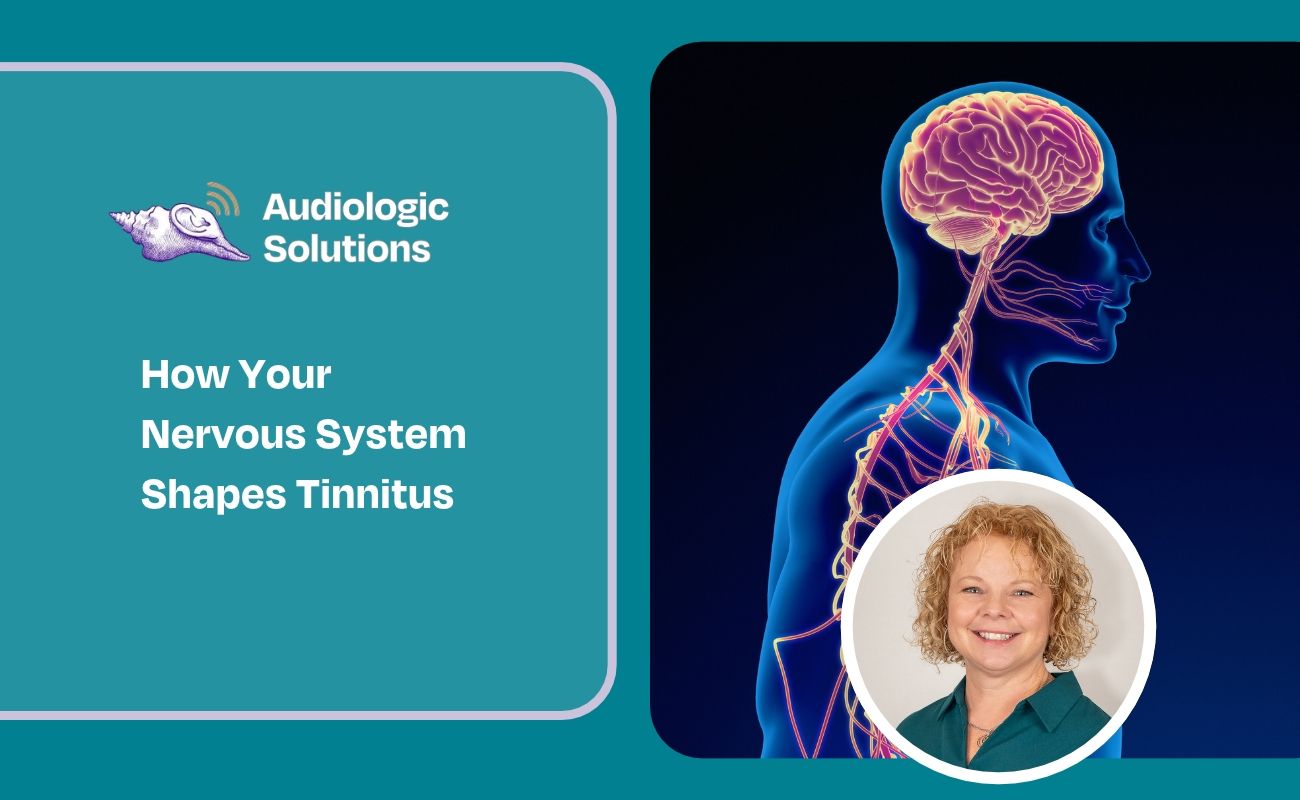

If you live with tinnitus, you may have noticed that the ringing feels louder on stressful days and quieter when you’re relaxed. That connection is the focus of a two-part video series from Dr. Erin Walborn, our audiologist with a special interest in tinnitus and sound sensitivity, along with practical tools you can start using today.
Your autonomic nervous system works in the background to keep you safe. One branch, the sympathetic system, acts like a gas pedal, releasing adrenaline and cortisol when you need to act. The other branch, the parasympathetic system, includes the vagus nerve and supports the “rest and digest” state, when the body slows down and repairs itself.
Dr. Walborn draws on polyvagal theory, developed by researcher Stephen Porges, to describe how we shift between states of safety and connection, action, and shutdown. A related idea called neuroception describes how your nervous system constantly checks for cues of safety or danger without your conscious awareness. It reads your surroundings, the people around you, and internal signals like your heart rate, breathing, and muscle tension.
For some people with tinnitus, this alarm system becomes overly sensitive and keeps signaling danger even when nothing harmful is happening.
A healthy stress response has a beginning, a middle, and an end. In the first video, Dr. Walborn shows an impala that survives an attack, shakes its whole body to release the built-up stress, and returns to its normal routine. People tend to replay the event and worry about what comes next instead, keeping the body on alert long after the moment has passed.
Tinnitus can get caught in a similar loop. When the brain treats the sound as a threat, it pays closer attention, which raises stress, which draws even more attention to the sound. Many people notice their tinnitus has faded for a few minutes and then go looking for it, which brings it right back.
The way we talk to ourselves matters too. Thoughts like “this ringing is ruining my life” tend to speed up the heart and tighten the muscles, which the body reads as danger. Dr. Walborn suggests gentler statements, such as “In this moment, I am safe” and “I can change how I respond to it.” Because so much of the vagus nerve’s signaling travels from the body up to the brain, she encourages patients to practice calming techniques regularly so the body can experience safety firsthand.
The second video is a mindful regulation toolkit with guided practices you can follow along with Dr. Walborn. A few to try:
Dr. Walborn stresses consistency. Five minutes a day, practiced regularly, is what builds resilience over time, and when your mind wanders, the skill is simply returning to an anchor such as your breath.
Dr. Walborn is a qualified teacher of Mindfulness-Based Stress Reduction (MBSR), an eight-week program Jon Kabat-Zinn developed in 1979 that has since been studied extensively. A 2019 systematic review in Frontiers in Neurology looked at mindfulness-based programs for adults with tinnitus and found that six of seven studies showed a significant drop in tinnitus distress right after treatment. The researchers noted that the long-term effects still need more study.
Dr. Walborn holds a Certificate in Tinnitus Management (CH-TM) and serves as Secretary on the Board of Directors of the American Tinnitus Association. Her videos are general education, and because tinnitus is a symptom that can point to an underlying issue, a thorough evaluation comes first. From there, she builds an individualized treatment plan that may include some of these practices along with options like hearing aids or the Lenire tinnitus treatment device.
Dr. Walborn sees patients at our Rensselaer and Hudson offices. To schedule a tinnitus evaluation, call our Rensselaer office at (518) 283-6111 or our Hudson office at (518) 828-7700.







We have 4 hearing care clinics in Rensselaer, Hudson, Saratoga Springs and Queensbury.


